

Hallway Nook Walls & Pleated Ceiling
Location: Notting Hill / UK
Designer: Marsha Abegg / Residential

Small hallway nook with pleated silk ceiling for designer Marsha Abegg. Hallway fabric in with a self made double piping and ceiling in silk.


Campbell - Rey x SCHUMACHER GARDEN ROOM
Location: Chelsea Design Centre Wow!house
Designer: Campbell - Rey / Residential
WOW!house is a unique 400 sqm showhouse, built within the Design Avenue at Design Centre, Chelsea Harbour. This event is an impressive and immersive design experience, featuring 17 full-size rooms, each created by world-class interior designers, for visitors to explore, enjoy and find the ultimate inspiration.
We were lucky to have been asked by designers Campbell - Rey and fabric company Schumacher to help them put together the Garden Room by installing fabric to the walls.

The plan was to cover three out of four walls with the Schumacher Paley Quilted Velvet. Using a palette of bold tonal greens, contrasting textures and unexpected furniture pieces from a range of eras upholstered in Schumacher’s iconic designs, the overall effect is at once striking, cultured and thoroughly alluring.

“A layered and eclectic garden room that transports the viewer to another world.”


PAPER-BACKED FABRIC, IS IT REALLY A BETTER ALTERNATIVE?
I was recently contacted by a journalist Arabella Youens to help with an article she was writing for Homes & Gardens about fabric walling and how it sums up against a paper-backed fabric. There was so much informative information I wanted to share with her for the article - I thought why not make a post about the topic!
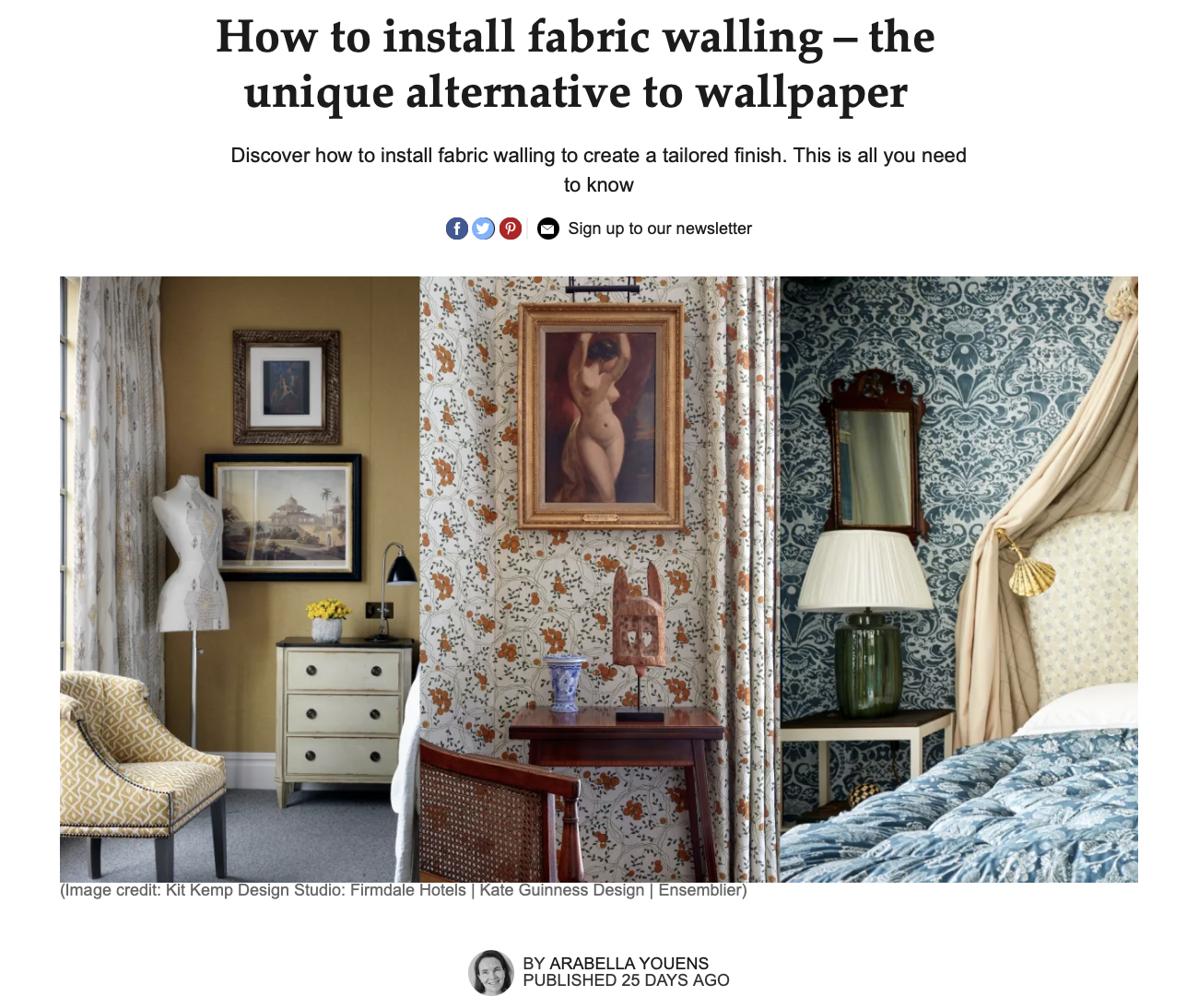
Fabric vs Paper-Backed….
It’s common to hear fabric walling is a more expensive method of finish in a room compared to wallpaper. It’s a quite a high-end finish and a specialist niche, there are not too many of us that know how to install fabric onto walls.
But does paper-backing a fabric give you a better result at a cheaper cost? I’m not convinced! I’m going to explain why paper-backing your fabric may not be the cheaper alternative to fabric walling, and how fabric walling can provide a better quality finish as well as offering a wider range of fabrics, patterns and finishes.
I have experienced TWO scenarios in the last 6 months where the designer has contacted me for help when the paper-backed fabric hasn’t quite worked out….
On the first occasion, the designer had tried to paper-back their own “check fabric” for the walls in a tiny bedroom. Unfortunately, the fabric didn’t stay uniform and straight during the backing process. Instead, we battened and padded the room and ceiling then stitched and stretched their fabric over the top, perfectly straight and uniform. Problem solved!


On the second occasion, the paper-backed plain hessian fabric had been applied to the walls. The joins looked very thick and heavy protruding from the wall making the seams look unsightly. The paper-backing companys solution was to run a braid or trim down each seam to conceal the join. Not only would this not solve the protruding issue, it would draw further attention to the joins!
What’s the cost Of The Backing Process?
I do not know the costs involved in the installation a fabric paper-backed fabric, nor the time involved in preparing a room for wallpaper or fabric-backed paper. I do know the cost of having the fabric treated is relatively in-expensive at £10 + VAT per metre.
However- preparing the room for a wallpaper or a paper-backed fabric could be very similar in cost to having your walls upholstered in fabric. We don’t need 100% smooth plastered, primed twice walls pre lined with a thick gauge wallpaper lining to work from and that’s because we use padded interlining between the fabric and the wall, the walls does not need to be perfectly smooth..
Why The Decision To Have Fabric Backed With Paper In The First Place?
Wallpaper is mostly manufactured at a smaller width than fabric, so the aesthetics of having a fabric paper-backed means less joins or seams.
Textile paper backing does have more sound absorption and insulation properties, than wallpaper.
Coordinate upholstery, window treatments, and soft furnishing to your fabric paper-backed wall covering. Printing on paper to make wallpaper and applying the same print to fabric doesn’t always match to look exactly the same! If you want your soft-furnishings to match your walls then you need to apply fabric to the walls , as you can’t use wallpaper to make curtains. I’ve written a blog post about the comparison.
The above lists some good reasons. But all points are ALSO the same, if not better, when you have a room upholstered in fabric, so really there is no need to put the fabric through a backing process.
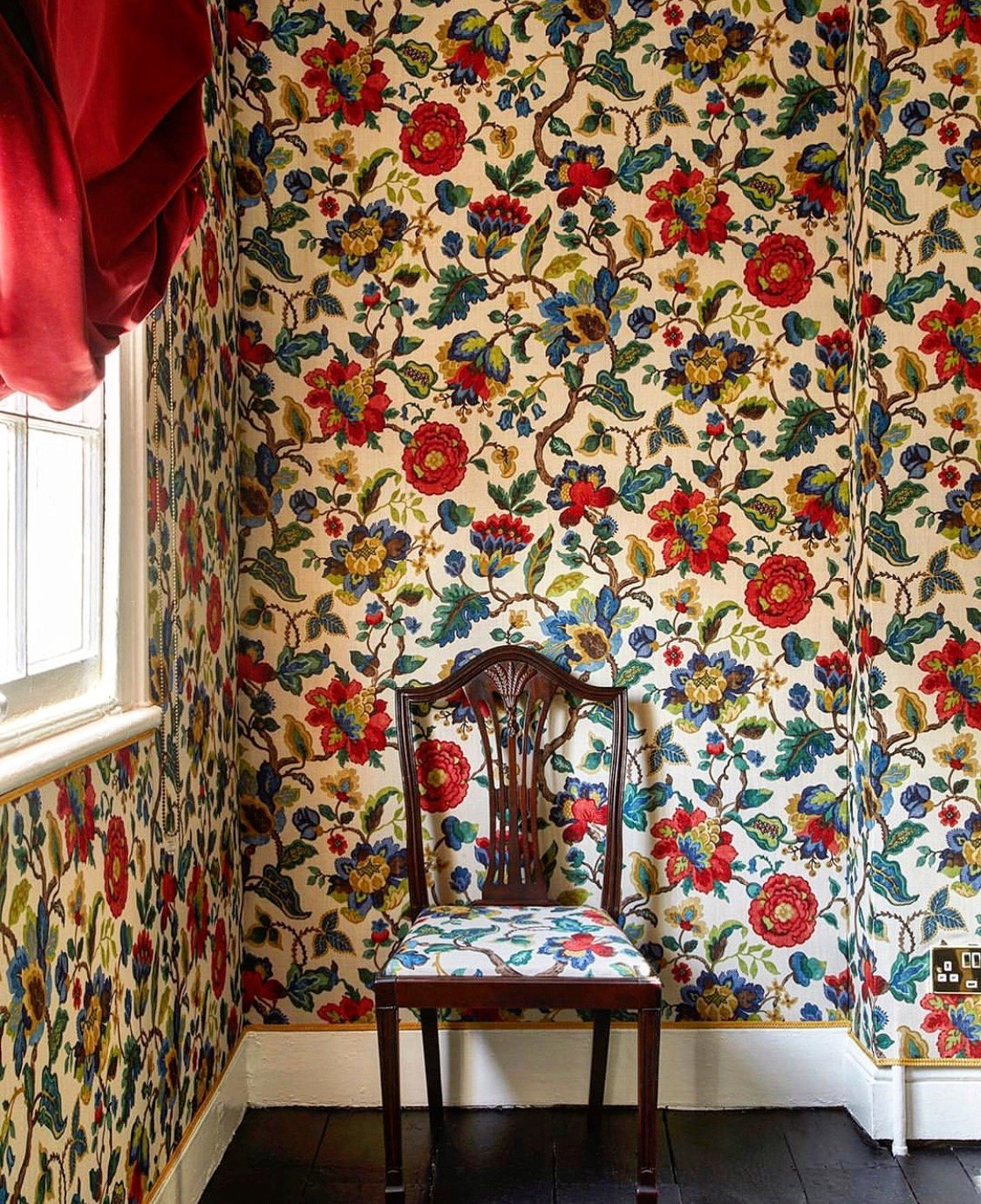
why not just skip the backing process and just Line Your Walls With Fabric…
Stretched fabric walling will also give you less seams compared to wallpaper, yes! Stretching fabric across your walls is going to help with the acoustics and insulation even MORE so than a paper-backed alternative because we line the walls with a wadding (and sometimes even acoustic foam in rooms that are very echoey) before fabric is stretched over the top.
Using fabric on the walls means we can also help you match EXACTLY the same material you use on your soft furnishings, cushions, headboard, lamps etc. if you are doing the matchy matchy trend! Plus your expensive hand-printed fabric won’t feel stiff like paper, it will feel soft to the touch like…. well, fabric.
“‘Fabric insulates, in summer it keeps the heat out, and in winter the warmth in. There is also a certain depth and texture which you don’t get with paper that I love.’ ”
Why You Might Want To Think Twice About Paper-Backing Your Fabric…
I’m going to give you a few reasons to WHY paper-backing a fabric doesn’t always achieve a luxurious finish, or even a neat result after it’s been applied to the walls.
I’m going to use some helpful quotes from companies that provide the paperbacked fabric service….
“The process is NOT recommended for fabrics with horizontal repeats”. That folks, includes all checks and stripes, big and small! “Some fabrics may bow across the width after paper-backing. Any bowing below 5cms shall be considered normal.” a potential 5cms is an incredible amount of discrepancy! With fabric walling we can use the fabric exactly as it comes so there will be no risk of bowing.
“Avoid fabrics that must have a precise pattern match of a motif where the joins meet, for example a branch or a tree.” So putting it bluntly, you may not be able to use a patterned fabric at all because you cannot guarantee it will match up to the next drop….and you may not find this out until your poor installer begins hanging the paper-backed fabric. By this point you may have paid for the fabric, the back process and the specialist installer! During the process of paper-backing, it seems like the fabric is subject to moving which will make the pattern shift across the width. Again, we are able to use the fabric as it comes and we meticulously pattern match it on the sewing machine, creating nearly invisible seams.
“Not recommended for loosely woven fabrics.” I do concur with this! I wouldn’t particularly want to apply a loosely woven fabric directly over our wadding. It wouldn’t look nice to see the wadding or even the paper-backing through the weave of the fabric. However, using stretched fabric walling, we have a solution. We can use a second lining over the wadding in a plain fabric hand picked to be a similar colour to the loosely woven fabric, to prevent the wadding being seen through the weave.
“It is important to be aware that the finished effect will be panelled and not seamless. We recommend the use of cord to trim along the seams, particularly on thicker paperbacked fabrics to protect and hide the seams.” This is where I am a bit lost for words. Ideally, the less you see a seam the better. By attaching a braid or a cord to the vertical seams it will only draw your eye towards them further. We love using braids and trims on our projects to frame a wall but only ever along the bottom and top edges where the fabric is stapled and meets the skirting, cornice, doors and windows etc.. our seams are always stitched and matched if patterned to the next drop of fabric eliminating the need to ever vertically place a trim top to bottom on every seam- causing them to be as invisible as possible.
It's always advisable to have the fabric tested first with the backing company and they happily provide this service to you - but only after you have sent them your entire length of fabric plus 1 metre extra to test first.

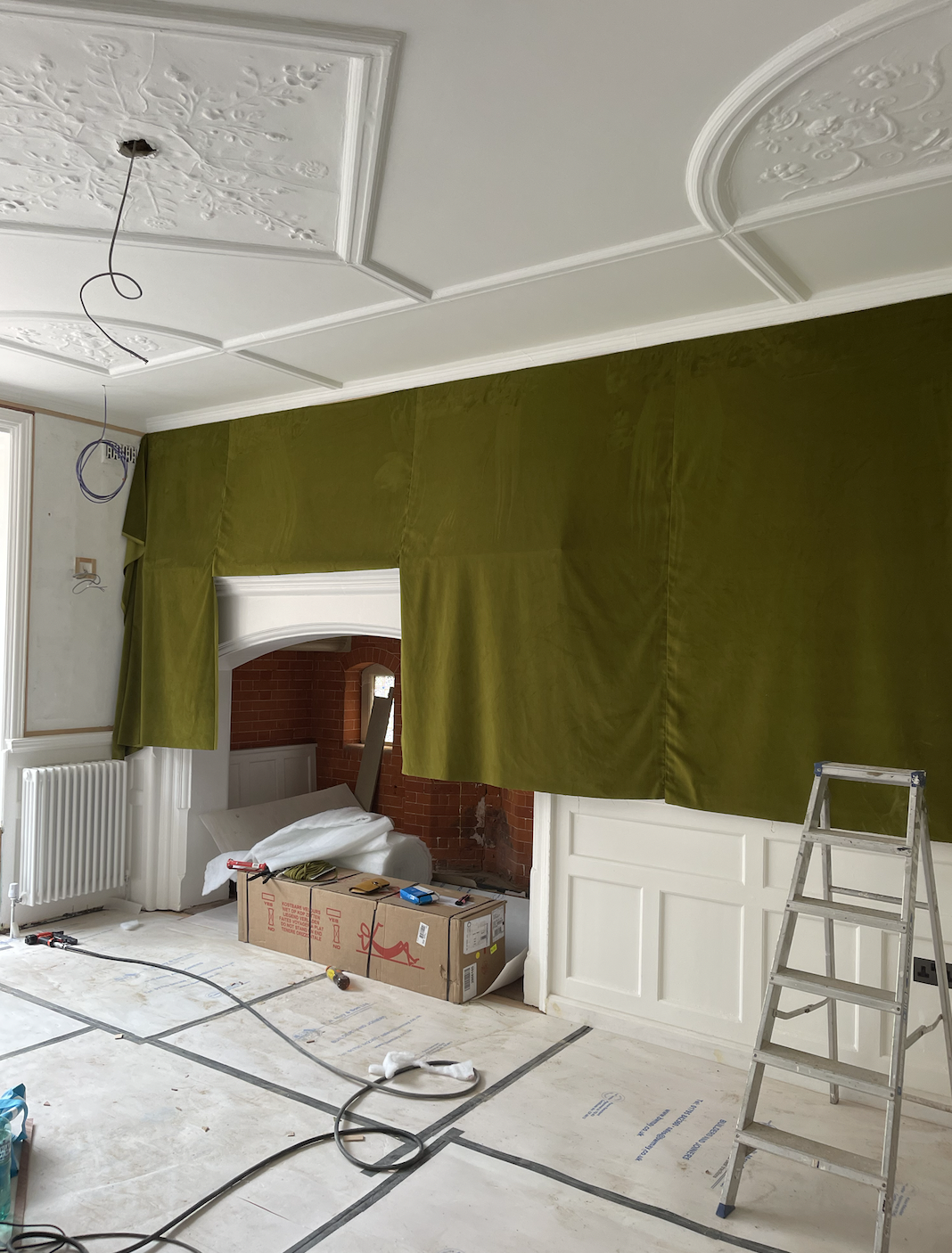
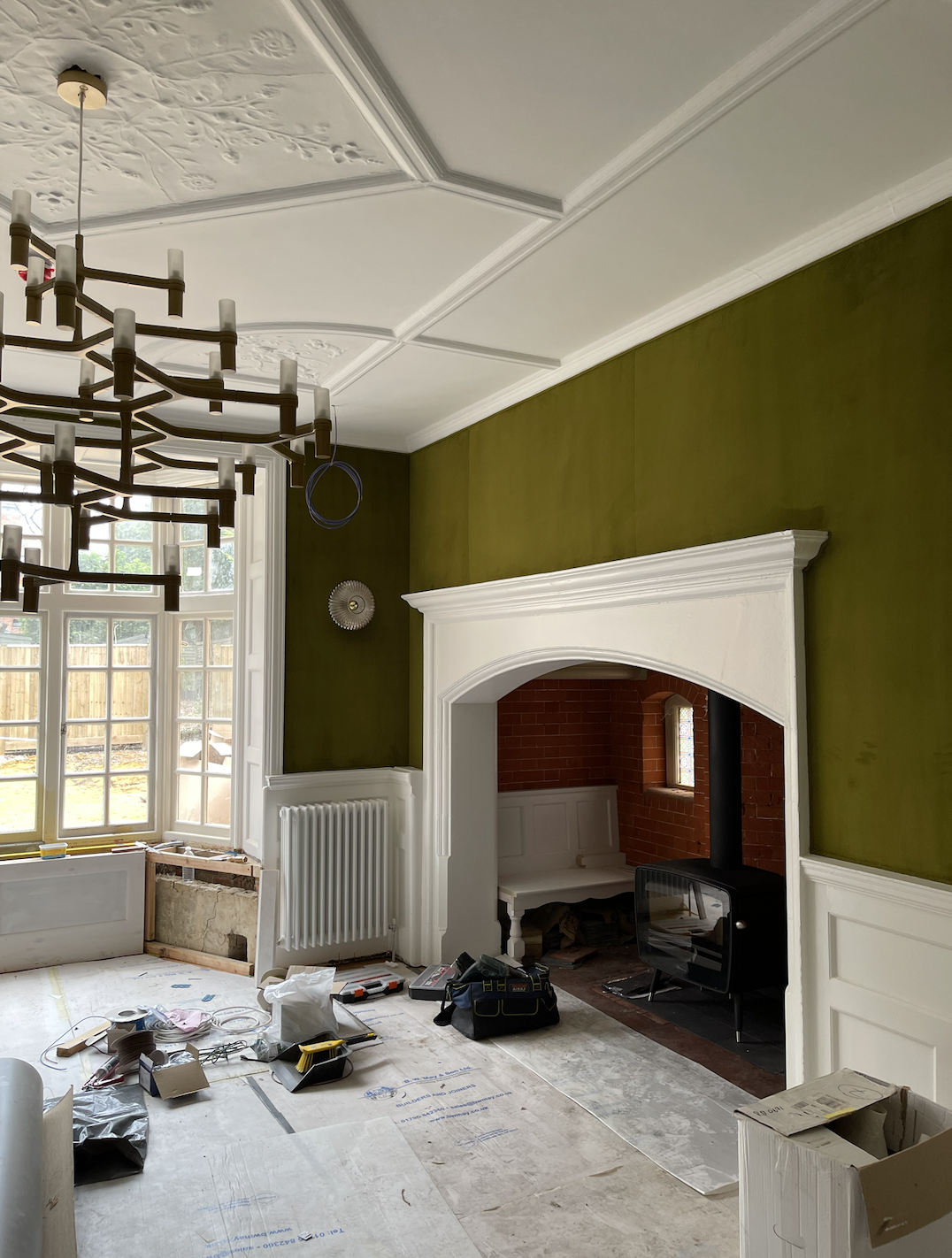
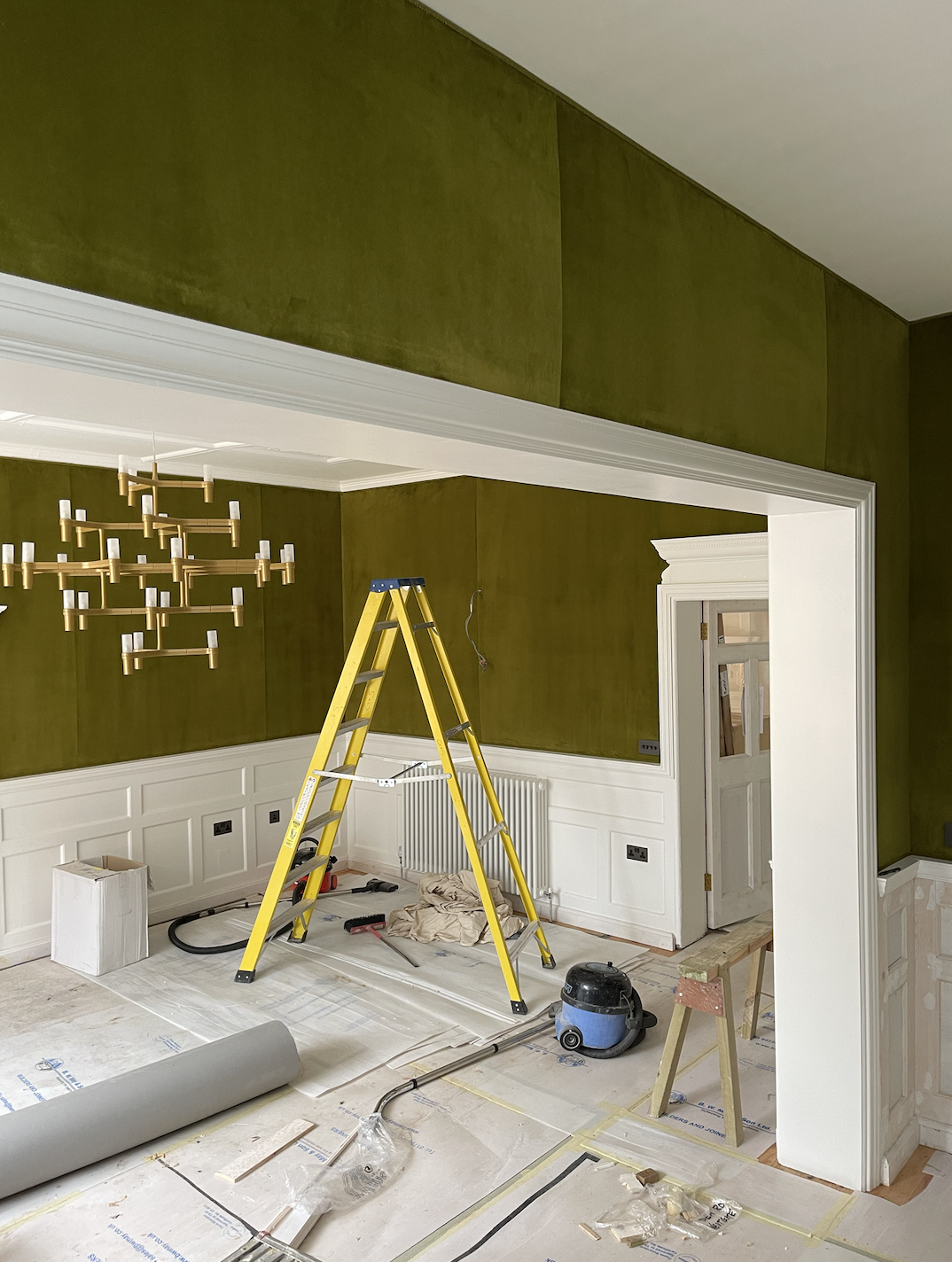
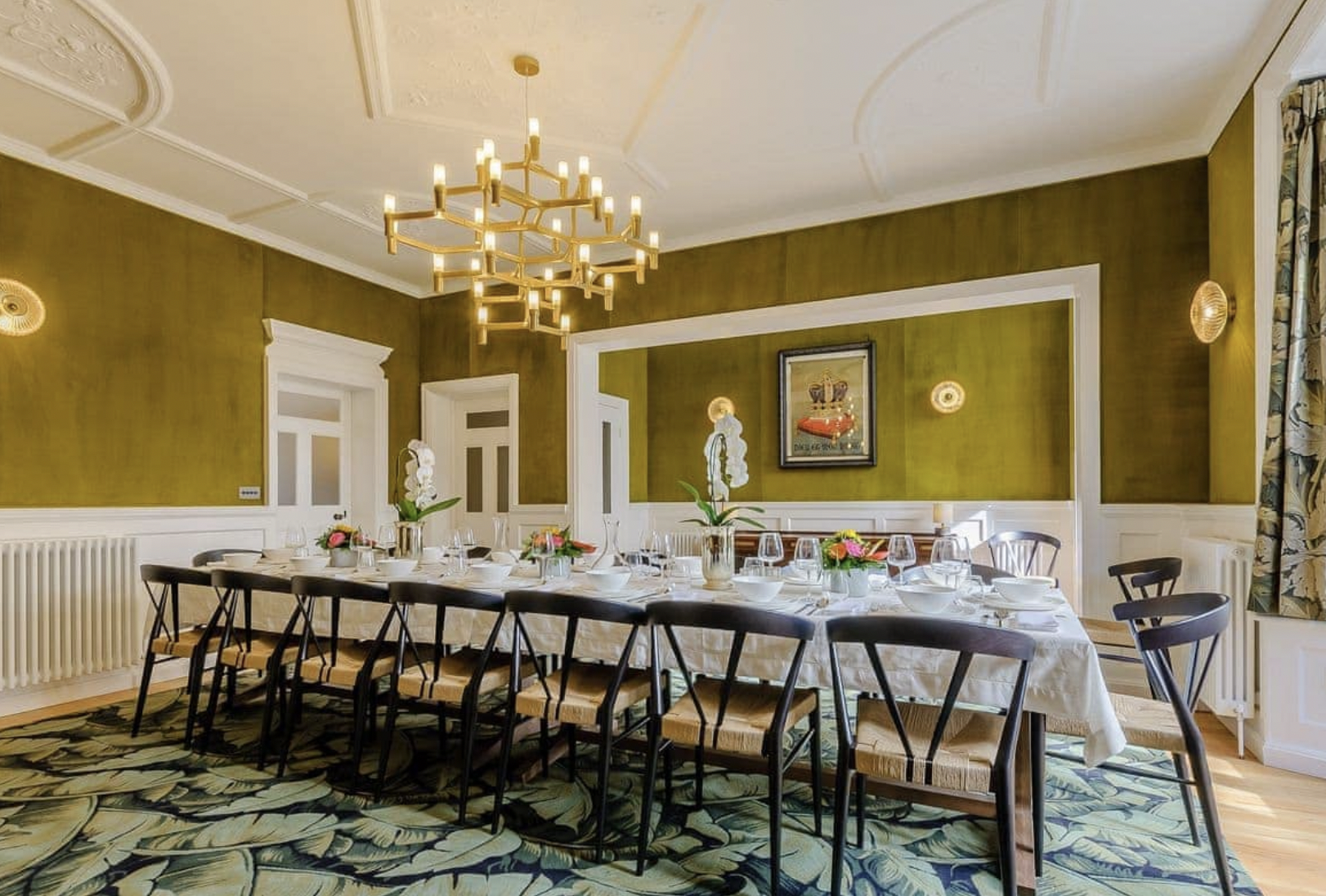
Here is a project we did for a guest house in Westgate-On-Sea. We stitched, hung and stretched drops of beautiful olive green fabric together over the walls of a dining room. Velvet is so tactile for this type of room in both size and space, dulling down the sound or the acoustics especially when events and dinners are being held!
“‘Fabric walling has its roots in tradition, but this craft is very much alive today for both historic and contemporary interiors: fabrics beautify walls.’”


Below is an example of what paper-backing a velvet COULD look like, depending on the velvet and pile size. The pile is flattened and discoloured as its been pulled through the rollers. The fabric has then been re-rolled and possibly not packaged and delivered back to the client in a ‘suspended’ cardboard box.


Is a Paper-Backed Fabric Finish Cheaper?
Whilst doing my research into this topic, I was surprised to see a number of really well known reputable fabric companies along with of course the fabric paper-backing service providers insisting ‘paper-backed fabric IS a cheaper alternative to fabric lined walls.’ This is a bit misleading because we firstly have to understand the preparation involved to get a room ready for both types of finish!
The below information does of course depend on the project or room stage of course, but for an example let’s say this is a home that’s having a complete fit out with new walls.
1.Hire an expert.
Both finishes need a specialist installer!
PAPER-BACKED FABRIC: You need to find an installer that’s familiar with a paper-backed fabric because it’s not quite the same as hanging a wallpaper. ALL paper-backed fabrics arrive untrimmed and if you know what a width of fabric on the roll looks like then you will have seen something called a selvedge. This runs on both sides of the roll and needs be hand trimmed before you can hang the paper-backed fabric. The cut needs to be accurate - there is no room for error!
FABRIC WALLING: You need an experienced installer to hang and stretch fabric to line the walls in a room and to calculate precise quantities needed. You may need a little more fabric than wallpaper to equate for our fabric return at the corners, but quantities should only be marginally more. Unlike a paper-backed fabric we machine stitch the drops together (twice for extra strength) making one whole piece per wall. If a mistake is made while stitching the fabric together (for example the pattern doesn’t quite match) we unpick and re-stitch!

2. Preparing the room for your expert installer.
To install any final finish to a room, whether painting or hanging paper, your installer will request a clean, dust free and clear space to work in. I have learnt over time that it’s a really good idea to give the contractor on site a list, to help make sure the room is ready for the final touches. I ask for the following to be in place before we install fabric, similar points (and then some) would apply if you are installing wallpaper or fabric-backed paper.
Any fittings and fixings that will be attached to or sit in the fabric walled area must be onsite by the start date. This includes: wall lights, curtain poles, radiators, switches, sockets or anything else that might be attached to the walled area using screws.
Fill in any large gaps or holes in the walls either with a filler or piece of plywood. This could include any redundant socket points.
Make sure the wall is clean & even in colour.
Ensure all skirting, coving and architraves are in place.
Remove any radiators, towel rails, tv brackets etc. These elements can be re- installed easily after fabric walling.
All painting and decorating to be complete and dry before fabric walling installation commences.
Ensure final lighting and electrical scheme or first fix is in place before fabric installation. Second fix can proceed after we have installed the fabric.
There is significantly more preparation work your contractor needs to achieve before you can have a paper-backed fabric applied to the walls, compared to stretch fabric walling. All this extra time needed to prepare only adds to the cost of the final finish when using a paper backed method.
PAPER-BACKED FABRIC: Walls need to be fully plastered before a paper-backed fabric can be applied. Surfaces should be dry, smooth, flat and free of any loose material. Your paper-backed fabric will not disguise any imperfections you may have on the face of the wall! New plaster is extremely absorbent so all surfaces must be properly sealed in advance. If your paper-backed fabric adhesive paste is applied directly to new plaster, it will suck the moisture out of the paste before it has a chance to dry fully. It is best practice to apply two coats of sizing sealant.
FABRIC WALLING: This method is way more versatile as we can fix our prep-work build up (the wooden battens) to hold fabric onto almost any surface: brick, plasterboard, plaster, ply, concrete, wallpaper, wood paneling, textured paint and even old wattle and daub. All we require is that the wall is structurally stable. We can also cover and hide acoustic elements and insulation like rockwool. We are able to build up our framework onto the walls to variable thickness to make sure the fabric and our wadding will cover structural imperfections in a wall’s surface - I have even concealed a small pipe in a project which obstructed the face of a wall! We only ask that all surfaces are of an even colour, just a quick coat of white paint will do!
3. Lining the walls.
PAPER-BACKED FABRIC: All walls should be lined with a plain white heavy grade lining paper . In the UK, a suitable lining paper would be classified as 1000 or 1200 grade. The lining paper should be hung with the same adhesive being used to hang the final panels.
FABRIC WALLING: Fabric walling wouldn’t be fabric walling without a layer of soft wadding between the wall and the fabric. The wadding has wonderful acoustic properties which you benefit from as well as helping with the insulation. The wadding layer acts as a barrier but also softens the look of the fabric which is stretched over the top, stopping the fabric from looking visually hard and flat- like a wallpaper- and instead making it look soft and inviting.


4. Join or seam placement of your fabric.
Finally the time has come where you begin to see your room come together, the boring prep-work is out of the way and the moment of excitement can begin.
PAPER-BACKED FABRIC: I would strongly advise you check with the installer where there ‘join placement’ will be. Remember the start of this post when I wrote about the paper-backing company recommending “the use of cord to trim along the seams,” to protect and hide the joins. If you must to resort to having the joining edges ‘hidden’ by a braid after installation you MUST have placement of the drops hung symmetrically onto the wall or your now highlighted joined will look unsightly.
FABRIC WALLING: I use a strategic plan when I hang the drops of fabric, tailored to each wall as no two projects are the same. There is a method for hanging a patterned fabric and another method to hang a plain fabric. Scroll down very some pictures of our fabric walls on various projects.
Patterned fabric method: The unavoidable stitched seams should more of less become lost in the pattern when accurately matched, but they are there and visible if you really want to look for them. We always start by aligning the middle drop of fabric to the centre of your focal wall. The focal wall is where your fireplace is, where your headboard is placed, where the cinema screen sits; its the first wall you look at when you enter the room! The focal wall is our starting point, from here we work left and right around the room from that central point. With seam placement around the rest of the room you are dictated by the pattern and have less control (compared to a plain fabric) as to where the seams fall as we pattern match each corner.
Plain fabric method: Unlike a patterned fabric you are NOT dictated where your seams fall. This means we are able to symmetrically place the drops of fabric to each wall symmetrically.
Would you like a seamless wall?
It doesn’t matter if your installing wallpaper, fabric or paper-backed fabric, joins are inevitable. There is only one way to have totally seamless walls and that’s by using a double width fabric. Unlike wallpaper, fabric can be produced as a ‘double width’ of, on average, 2.6 metres. Turn this wide length on its side (called railroading) the width of the roll now runs vertically. You no longer need to cut and stitch drops of fabric together you can just have one large piece of seamless fabric per wall. Because the length of the fabric now runs vertically, this is only an option for plain fabrics or patterns that would not look out of the ordinary on its side.
You can find examples of our seam placement here: COMING SOON


5. Lastly, fixing your fabric or paper-backed fabric in position.
PAPER-BACKED FABRIC: This is why you need an expert with lots of experience! You must be careful the adhesive does not come into contact with the face of the wall-covering. Do not attempt to hang a wall-covering onto glossy, glazed or varnished surfaces without keying the surface thoroughly to achieve sufficient adhesion before proceeding. It is advisable to remove such a surface entirely! You also need to make sure the selvedge edges are trimmed precisely so they MIGHT match up to the next drop. (Remember the companies previous disclaimer..)
FABRIC WALLING: Luckily, we don’t need to use any solvent or adhesive to apply the fabric onto the wall. Instead, we stitch the drops together (which can always be undone if the match isn’t close to perfect). We use a pneumatic staple gun to fix the fabric onto the walls, only needed a simple braid or piping to cover our staple line, neatly framing the walls. Braid or piping comes at an additional cost and there is a wide and beautiful range out there to compliment your scheme. You can source accordingly to your budget and I have listed some of my favourite companies to use HERE.
“All bedroom walls should be fabric walled. It is indulgent, but it dampens the sound and makes a room feel cozy.”

I hope I have ENCOURAGED you…
to think about fabric walling as an achievable option that’s within your budget, as I don’t believe fabric walling should be deemed more expensive than the paper-backed method. Sometimes, the most expensive part of the project is the fabric itself and not the labour or process!
This post should show you that while both processes require a similar amount of expertise and preparation, the fabric walling method allows you to retain more control over the final finish of the pattern. After all, by not adding a stiff paper like quality to the fabric you allow it to retain it’s soft feel- making fabric act as fabric.
TWEED LINED ROOM, ISLE OF HARRIS
If you would like us to quote on a project we can easily give you an estimate via email. All we need to know are the height and width of each individual wall, the size of any windows and doors, and for you to provide a photo of each wall in question. If you have chosen a fabric already, please send us a the fabric specification or website link. We can then get back to you with our labour cost and how many metres of fabric you might need. We can also help you to source the perfect fabric if you are still undecided!
And if you have had any positive things to say about paper-backing fabric to prove me wrong, leave a comment below!
Olive Velvet Walls for West Bay House
Location: Westgate-On-Sea, UK
Designer: Project Orange / Commercial Project


Who doesn’t love a large dining room covered in velvet walls? Its the ideal space to cover your walls with fabric, especially if your going to hold lots or large dinner parties!
Often a dining room acoustics can be awfully echoey especially with larger gatherings of people, you need lots of soft furnishings to absorb the sound.
West Bay House is a unique retreat for corporate retreats & events located on the North Kent Coast. A spacious house with nine grand bedrooms , media room, library, kitchen and one huge dining room that needed fabric lined walls!
The dining room space is vast with lots of original features and detailing, a huge bay window and fireplace.


Designed by Project Orange we were asked to help with applying a rich Olive Green velvet fabric to the walls.



Braids, Trims & Double Piping
Using Passementerie In Your Walling Project
At the end of an installation after the fabric has been applied to the walls, we need to finish our staple fixing line with a braid or a custom made double piping - a trim that’s made in your wall fabric.
The fixing line is where I have stapled the fabric to the batten which runs along the perimeter of the walls; skirting edge, cornice, architraves, window and door frames, around fireplaces. The staple line needs to be hidden!
It’s a topic we discus with our clients and designers frequently! There are so many options when it comes to choosing a trim, the possibilities are endless. Braids and trims come in varied widths, colours and patterns. Colour matching braids to your fabric for a subtle look or framing the wall upholstery with a contrasting braid for a more visual impact.


Image Credit: Samuel & Sons
Below are projects which show a Flat Braid Finish…..


Project for Tatty Bird Design, dressing room walls in banana yellow fabric by Olicana Textiles using a contrasting stiped trim from Houles.

Project for Retrouvius, guest bedroom in a Pierre Frey strip using a flat braid in blue by George Spencer Designs.


Project for Campbell-Rey, dressing room walls in a hot pink faux moire from Dedar using a Schumacher flat trim.
Here are a few of my favourite companies to look at when choosing a trim:
- Houles
J A Milton and Colly Brook are perfectly fine and braids sell from just a few pounds per metre.
Below are a few articles to inspire you:
How to embrace the timeless beauty of passementerie - House & Garden
Custom made double piping…


Project for Jessica Buckley Interiors, bedroom room walls & custom double piping in Paradise by Bennison Fabrics.
This is a really great option when your a bit stuck or you would rather use the wall fabric OR the same fabric as your curtains, headboard ect to soften the look around the edges.
It does take a bit of time to make and you will need to order a few extra metres of fabric but its a really lovely way to complete the work. I need a good length of 3 metres on average extra so I can cut the fabric on the ‘bias”. Cutting the fabric on the bias, at a 45 degree angle across the width, ensures the joins are at their widest apart giving fewer seams when joining.
However, its not recommend for thicker fabrics like velvet or a thick wool, the piping tends to look very chunky on the face of the wall. Its best to opt for a flat braid with your velvet room or wool covered room.
Below is the custom made double piping we made on project for Gunter & Co.

Basement Bar and Cinema Room
Location: Knightsbridge, UK
Designer: John Teall / Residential Project


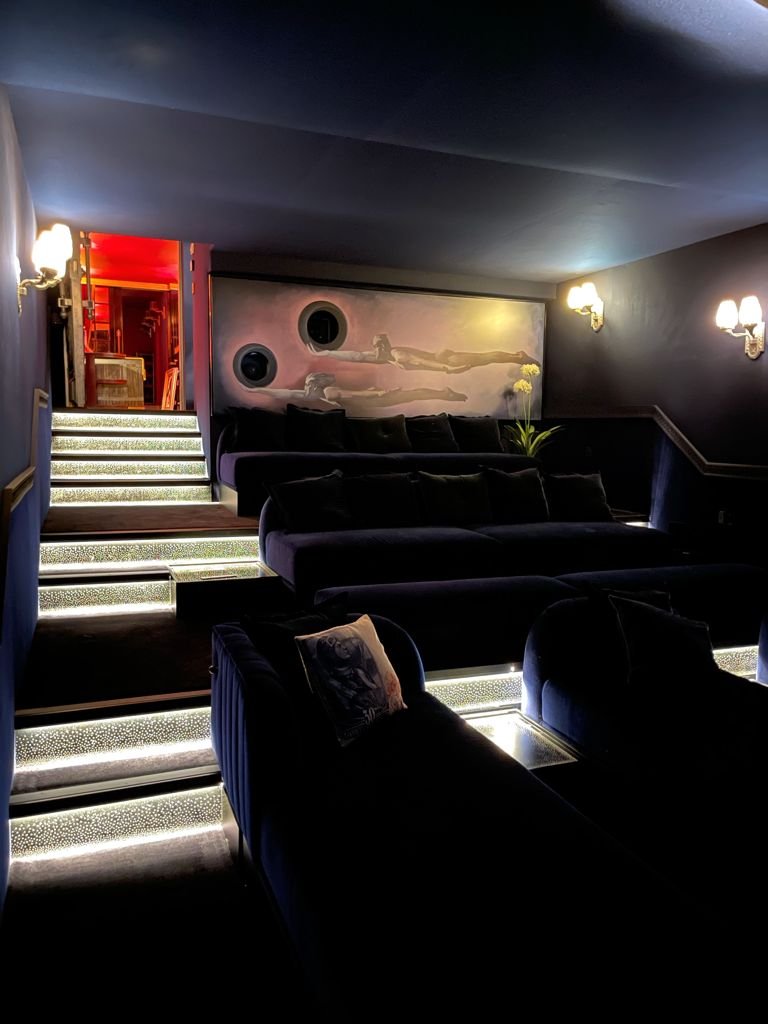
In early 2021 during the latter renovation stages of Rolland Emmerich’s new basement project at his Knightsbridge home, we were approached by the designer John Teall to cover the walls in both the cinema room and bar area in fabric.
In the cinema room John wanted to use a dark blue Dedar velvet below the dado rail and use an acoustic fabric above which seamlessly flowed onto the ceiling. Working alongside Hattoncrest Construction and AV Specialists we were able to hide the speakers and the acoustic elements build into the basement walls.
For the bar room again John chose a Dedar velvet in red for the walls below the dado rail and above John designed a custom printed striped linen.


Vaulted Dining Room Ceiling
Location: Northamptonshire, UK
Residential Project
Trying to come up with a solution to fix their acoustically loud garden room come dining room, I was approached by the clients to help make the room sound better. Primarily just glass windows the client wanted to add acoustic foam with a fabric to finish to dull the overall noise in the dining area below, hopefully making their voices less echoey.

With the ceilings and walls firstly lined in black acoustic foam and a layer of wadding I begin stretching a printed velvet to the ceiling of the room finishing with a holes braid in dark blue.

The walls have then been finished in a blue velvet to compliment the colours in the printed velvet ceiling.


Cotton Banana Split Walls
Location: Hampshire, UK
Designer: Tatty Bird Design / Residential Project
Natasha Birley at Tatty Bird Design got in touch with me after her upholstery loving sister found me on Tik Tok. She sent me drawings with measurements and pictures of the Master Bedroom at her clients property in Hampshire.
Below are the before images of the bedroom…


Natashas plan was to take away the exisiting wardrobes and cupboards around the bed and install a new built in wardrobe to the left hand side wall, decorate the ceiling, exisiting skirting and picture rail by painting it blue.
Natasha found a wonderful cotton called ‘Banana Split’ woven in the UK by Olicana Textiles to line the walls of the bedroom with.
Using a very traditional method of fabric walling, I firstly line the walls edges with wooden battening, this thickness can vary but I tend to stick with a depth of 6mm. The wooden battening frames doors, windows and any exisiting joinery, I also build up behind any light fittings or electrical fixtures - this is where I will stretch and finish the fabric too. In between the wooden battening I fix an insulated layer of wadding, this wadding will also help with the acoustics to a room.
The next step is to methodically work out where I am going to place the drops of fabric. I start with the main focal point of a room, this could be a fireplace or in the case of this room it will be the bed. Using a sewing machine I stitch 4 drops of fabric together and centre the seam between the second and third drop to the wall working the fabric stretching either side, top and bottom whilst keeping the seams straight.
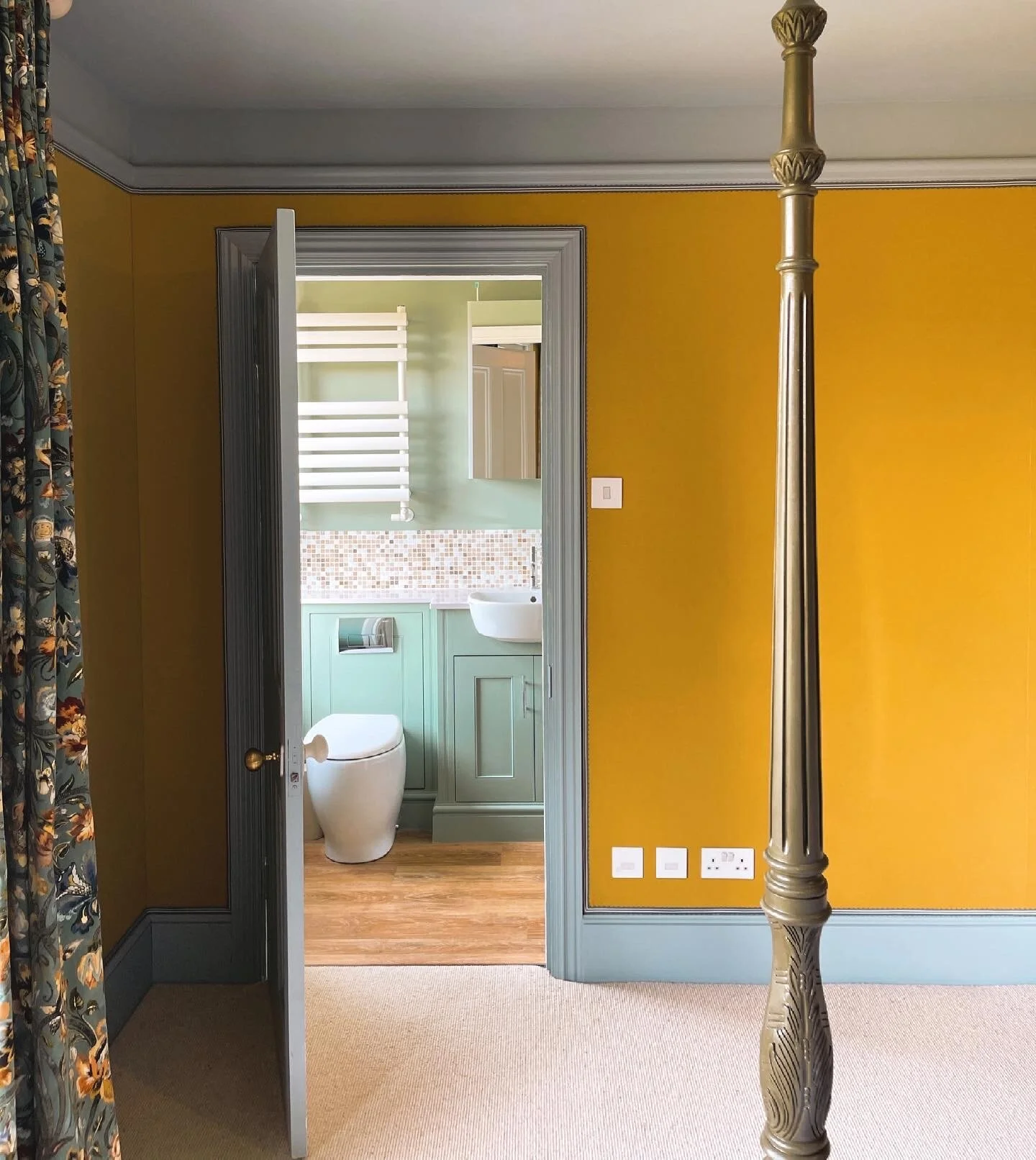
To complete the stretched fabric walls, Natasha choose a pretty contrast flat braid to compliment the fabric elements including the House of Hackney curtains bringing the room together. The braid is necessary to go over where I have fixed the fabric to the battening with staples. Scroll down to watch the ‘Work In Progress’ clip.


Downstairs Loo In Red Damask Silk
Location: Dorset
Designer: Floren Design / Residential Project
Neil at Floren Interior Design contacted me last year with an enquiry to transform his downstairs loo from wall paper to fabric lined walls in a silk brocatelles fabric by Italian company Luigi Bevilacqua a fabric with a lot of history behind it; in the 16th century in Italy, it was used mainly for upholstery and wall coverings in the palaces of illustrious members of the clergy and aristocracy.
‘Its particular texture with a strong linen weft made it possible to create, on a firm and even background, the elaborate textile decorations typical of the time, which made it the preferred fabric for luxury furnishings and religious vestments. The fortune of this fabric reached the baroque period.’


“I was keen to understand the alchemy of stretch fabric walling. Having seen some lovely work on social media and in magazines, I set about finding an expert. I discovered Hepzabeth on Instagram and was impressed by her helpful videos showing the process. We spoke on the phone and after some helpful explanations, I decided I would like to proceed. I had sourced the most beautiful silk Brocatello fabric from Venice and watched as Hepzabeth went about her magic. After 2 days, the end result was magnificent and truly a wallcovering for life. I’d like to thank Hepzabeth for her patience with all my questions and her attention to detail - stretch fabric walling is quite an art!”

Dressing Room Niche In Soane Fabric
Location: Battersea
Designer: Howark Design / Residential Project
After my initial suppliers meeting with James and Saskia from Howark Designs back in May 2019 it was brilliant to hear from them in 2020 with a project in mind for The Textile Wall Company.
Saskia and James were working on a fabulous project in Wandworth Common, London. In the dressing room off the Master Bedroom they wanted to incorporate a seating alcove with fabric walling and a little tented ceiling using Soane Scrolling Fern Frond in Indian yellow on Ivory linen finishing off the design with a contrast piping and border.


The work to create the upholstered nice begins by building up a frame around all edges and corners; this enables me to place padding in-between the battening and to stretch and fix the fabric into place on the very edge of the frame work sitting flush over the wadding underneath. The niche was small enough that no sewing was necessary, so once the back of the nice was in place I then proceed to pattern match and “back-tack” or return the fabric to both side panels, finally installing a pelmet which was finished with a contrast decorative trim which framed the pelmets shape.
I love working with pattern and colour so it was great to finally work for the duo that are Howark Designs - Saskia and James.


“‘Hepzabeth did an absolutely wonderful job in creating a beautiful upholstered seating area in a dressing room and 4 headboards for a project completed in October 2020. Throughout the process Hepzabeth was really quick to quote and respond to queries and was a real pleasure to work with, the quality of her work is excellent. The Client was absolutely delighted with the end result. We’re really looking forward to working with her in many more projects to come.’”


The Fitzdares Club
Location: Mayfair, UK
Designer: Rosanna Bossom / Commercial Project

It was such a pleasure when asked again by Rosanna Bossom to help with a project they were designing in Mayfair. Situated in the heart of Mayfair just off Oxford Street lies a pub called The Running Horse, above you can find members only club, The Fitzdares Club:
‘Starting as a pop-up in 2018, where passionate fans could watch live sport in both comfort and luxury. As it traversed across London’s most exclusive clubs, via Wentworth and Glorious Goodwood, its popularity grew. It needed a permanent location. On 1st September, the doors finally opened in Mayfair.
The Club’s chic interior serves as an idyllic backdrop to a bar, restaurant and three private rooms, all of which are armed with state-of-the-art televisions. There is no better place to indulge in delicious food, wine and sport.’
The Textile Wall Company were asked to cover all the walls of the ‘GAMES ROOM’ in a large printed patterned fabric. The client wanted to find an effective way to hide the old badly surfaced pub walls which lacked straight lines and in some places the walls didn’t quite exist making it difficult for other alternative wall covering methods like wallpaper or simply paint.
Watch the clip we made to see the walls and space before we started working some our magic!
Using the more traditionally method of fabric walling, we built and framed edges of walls with wooden battening, this defined any uneven edges giving structure and cleaner lines. We built up our framework on the chimney breast / TV wall to hide a pipe that stuck out profusely from floor to ceiling, hiding the pipe neatly tucked behind fabric.
Published on the in the Financial Times ‘How to spend it’ magazine in October 2020 , the Textile Wall Company was lucky to get a little mention as a supplier on the project. You can read the article here INSIDE THE WORLDS POSHEST BOOKIES


“Hepzabeth was one of the real stars of our very fast build. Her attention to detail is insane and she delivered under budget and on time. We were honoured when the Financial Times How to spend it featured her work. The Textile Wall Company really is best in class and we have had to recommend them to the endless admirers who have commented on the amazing fabric walls.”


Study Walls In Rosa Bernal Fabric
Location: Islington
Designer: Kate Guinness / Residential Project
I was delighted when Kate Guinness Designs got in touch after our initial meeting last July to discuss covering the walls of a study in a printed linen called Sevilla by The Rosa Bernal Collection.
For the study Kate asked me to use the ‘clean edge method’ of stretched fabric walling which meant there was no need for a braid or piping at the end to finish the wall; the fabric is neatly tucked into a hidden system that frames the wall edges.

On this project I stretched and fixed the fabric onto a con-caved wall following the lines of the study. Slightly more challenging yet but nonetheless very effective was to pattern-match three cupboard doors to blend into the room seamlessly. Kate also choose clear electrical plate facings which were covered in fabric made to pattern match against the wall, hidden and camouflaged.


Small Chelsea Textiles Print
Location: Knightsbridge
Designer: Rosanna Bossom / Residential Project
Fabric lined walls in Knightsbridge, London for interior designer Rosanna Bossom.
The walls of the living and dining area are covered in Chelsea Textiles "Cupid in Mauve”. The fabric is a small design hand screen printed onto cotton. You can watch the process of how I prepared the walls first and then applied the fabric below, watch me sew and pattern match over 20 metres of fabric just for one wall!


“Fabric walling or wall upholstery is a finish intended to make a room feel beautiful, comfortable and acoustically sound. Unlike wall panels made off site, our technique is created on-site and custom to the room itself making our team easily accessible to travel anywhere around the country to complete your upholstered wall or room. Do you have a room you would like to see finished in fabric? We have completed work in the following rooms: bedrooms, living rooms, libraries, residential studies, home cinemas, hotels and even yachts. We work with a wide variety of fabric including velvet, linen, wool and cotton. Plain, patterned and striped. The fabric is applied to a wall, room or space creating a smooth fluidity and tailored look unlike wall panels. "
Small Blue Patterned Fabric Walls
Location: Potts Point, Sydney
Designer: Cameron Kimber / Residential Project


Created for designer Cameron Kimber when we were based in Sydney. The walls of his bedroom were lined in a blue printed lightweight cotton using the modern method of wall upholstery which gives a clean finish, no need to hide staples with a braid or piping. Pelmet and headboard were also custom made to match the room along with the pair of antique chairs.